
 Menu
MenuOverview of the Gazetteer
The Gazetteer of British Place Names has four main features:
- it provides an exhaustive. searchable index to over 300,000 place names in the United Kingdom (hamlets, villages, towns, cities, urban areas, heritage sites, landscape features etc.), providing a brief description of each place;
- it provides a unique GBPN ID for each place and a unique GBPN URL link to the full information about that place;
- it relates each place name to its historic county;
- it relates each place name to a set of administrative areas;
- it provides a searchable, interactive map of the UK including all place names, historic counties and administrative areas.
Full details of all the data within the Gazetteer can be found in Contents of the Gazetteer.
The Gazetteer is based upon the fixed geographical framework provided by the historic counties of the UK. As such, it follows in a long tradition. The production of chorographical descriptions of Great Britain and Ireland on a county by county basis dates back at least as far as the first publication of William Camden's Britannia in 1586. Innumerable gazetteers, place name indexes and topographical dictionaries have subsequently followed this approach, among them being Samuel Lewis' A Topographical Dictionary of England and its companion volumes to Ireland, Scotland and Wales. The late 16th century also saw the publication of William Lambarde's Perambulation of Kent (1576), the first of countless such 'county histories', not least among them being the Victoria County History and Arthur Mee's The King's England series.
All of these publications are rooted in the fundamental understanding that the counties are the pre-eminent territorial divisions of Great Britain and Ireland. Their long lives and the place they play in our history and our sense of place make them the natural basis for the study and description of our geography, history, architecture, natural history and culture.
Whilst our historic counties are no longer generally used as a basis for public administration, they remain important geographical and cultural entities. To cease to use them as the basis for descriptions of our country and places within it would be to fracture the continuity of our history and condemn us to a future in which our notion of place and its many associations is based on the ever-shifting sands of contemporary public administration. Administrative areas are important, but should be understood in the contexts for which they exist and not used for a wider geographical or cultural role.
The Historic Counties of the United Kingdom
The Historic Counties Standard, published by the Historic Counties Trust, provides a comprehensive definition of the names, areas and borders of the historic counties of the United Kingdom.
The adjective ‘historic’ is a recent addition to the common noun 'county', used to refer to those 92 territorial areas which have formed the standard divisions of the country for many centuries. The need arose in the late 19th century to differentiate between the counties themselves and those ‘administrative counties’ first created at that time for local government purposes. Initially, the phrase ‘ancient or geographical county’ was commonly used (e.g. by the General Register Office, Ordnance Survey and Bartholomew’s Gazetteer) to make this distinction. The adjective ‘historic’ has since become more commonly used, e.g. by the Office for National Statistics, Encyclopaedia Britannica and Wikidata.
There has always been an understanding that the historic counties are distinct entities to the various administrative areas which have also been given the label 'county' since the late 19th century, and that the existence, names and areas of the historic counties are unaffected by the creation, alteration and abolition of such administrative areas. This is well expressed by the Office for National Statistics:
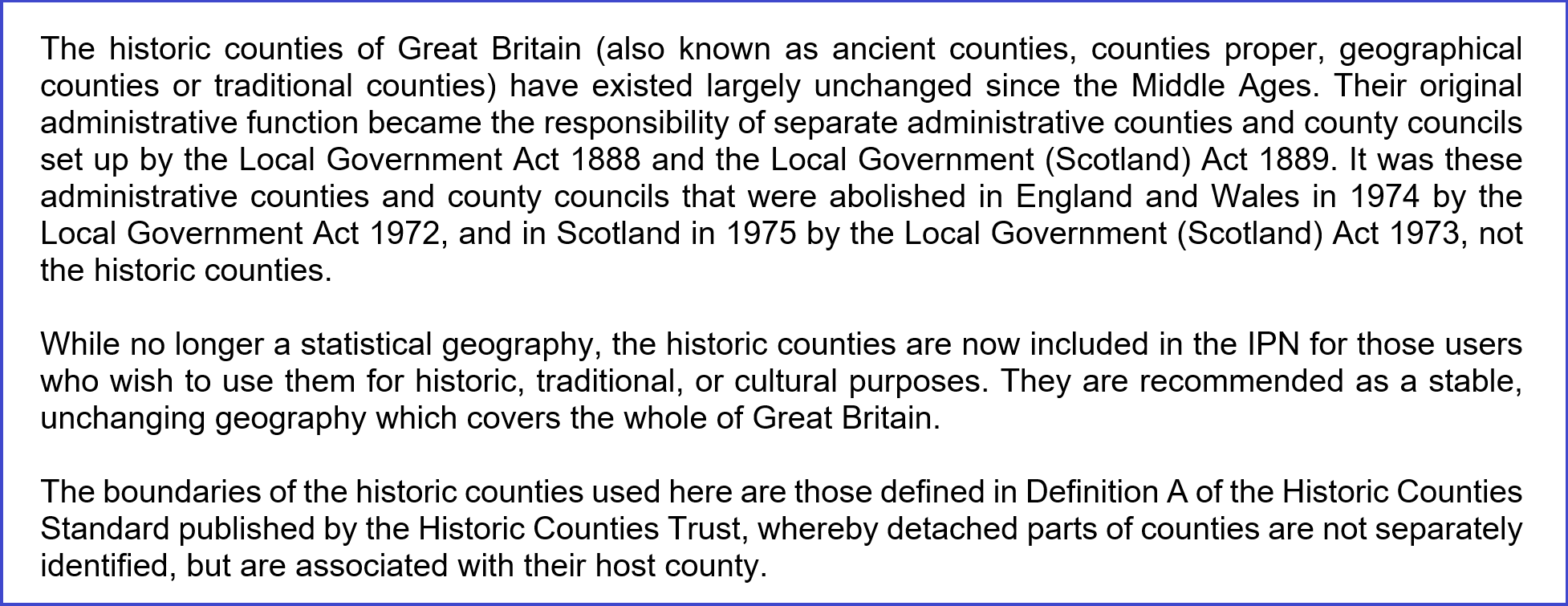
At the most fundamental level, the historic counties are ancient territorial units which, though no longer used as the basis for administration, remain of geographical and cultural importance. They are, though, far richer concepts than this. The historic counties are not just the landscapes into which our country is divided but are also the landscapes from which it is made up. Each has its own distinct culture: sets of towns and villages, peoples, dialects, building styles, natural histories, histories and traditions. They are the focus of loyalty and identity to millions. They are the basis of innumerable sporting, social and cultural organisations and events. Our history was played out within them. A huge literature, going back centuries, focuses on each historic shire. Above all else, the historic counties are ‘places’: places where people ‘come from’, where they ‘belong’. And they often provide a family link with past generations.
Administrative areas
The Gazetteer also presents a detailed description of the geographical organisation of the major forms of present-day public administration in the United Kingdom; describing the main types of administrative area, how and when each was created and the contexts in which each is relevant.
The following sets of administrative areas are included within the Gazetteer:
- Townland (TD) in Northern Ireland
- Civil Parish (CP) in England, Scotland and Northern Ireland
- Community (C) in Wales
- Council Area (CA)
- Strategic Authority Area (SA)
- Police Area (PA)
- Devolved Legislature
The townlands of Northern Ireland, the civil parishes of England, Scotland and Northern Ireland and the communities of Wales have their origins in areas which stretch back many centuries. This long history has made them, at a local level, areas of geographical and cultural importance, although their present-day administrative importance is limited.
The council areas, strategic authority areas, police areas and devolved legislatures are the geographies of the major forms of present-day public administration in the UK. Each of these administrative geographies is of relatively recent orgin and has been created by law for the execution of particular governmental functions.
The need for a fixed general-purpose geography
The United Kingdom needs a fixed general-purpose geography - a commonly accepted set of names and areas for use in media reports, business, tourism, education, addresses, sport, social and leisure activities.
Attempts in recent times by the media and publishing world to use local government areas as a basis for descriptions of geographical location are fatally flawed. The names, areas and structures of public administration change too frequently to be useful in a general-purpose geographical context.
Instead, the country needs a general-purpose geography which is fixed, popularly understood and firmly rooted in history, tradition and commonly held concepts of community and identity. The historic counties are the only credible choice.
The six counties of Northern Ireland, like those of Great Britain, are no longer used as the basis for any major form of public administration. Yet they are universally used as the standard geographical framework for Northern Ireland. The case for the adoption of this convention throughout the United Kingdom is overwhelming.
Disclaimer
Whilst every effort has been made to ensure the accuracy of the information within this gazetteer, the huge nature of such a publication means that errors must inevitably occur. We can do no better than to quote from the introduction to the 1848 edition of Lewes's Topographical Dictionary of England:
"The proprietors cannot entertain the hope that, in a work compiled from such a variety of sources, and containing notices so numerous and diversified, errors have not occurred. They have, however, regardless of expense, used the most indefatigable exertions to attain correctness, and to render the work as complete as possible; and they, therefore, trust that any occasional inaccuracy will receive the indulgence of the subscribers."